The Victim Trap in Engineering Management: How to Escape the Drama Triangle
Many engineering managers fall into the Victim role without realizing it, blaming PMs, execs, or their own teams. Here's how to break the cycle and lead with clarity.
One Thursday evening, my PM dropped a message in our team Slack:

I was absolutely furious.
There was no way we could fix everything without burning the entire weekend. And for what? The delays weren’t my fault - he kept increasing the scope with zero compromises.
Even worse - how could he promise that without consulting me?
I started writing an angry message to my manager, the PM, and the VP of Product. Then I stopped.
I realized I’d fallen into the Drama Triangle trap. Again.
In this article, I'll cover:
- What is the Drama Triangle
- 3 real examples from engineering management
- How to stop falling into the victim trap
What is the Drama Triangle?
The Drama Triangle is a model that explains how people fall into one of three roles during conflict or stress: Victim, Villain, and Hero.
Here's a visualization from this great video:
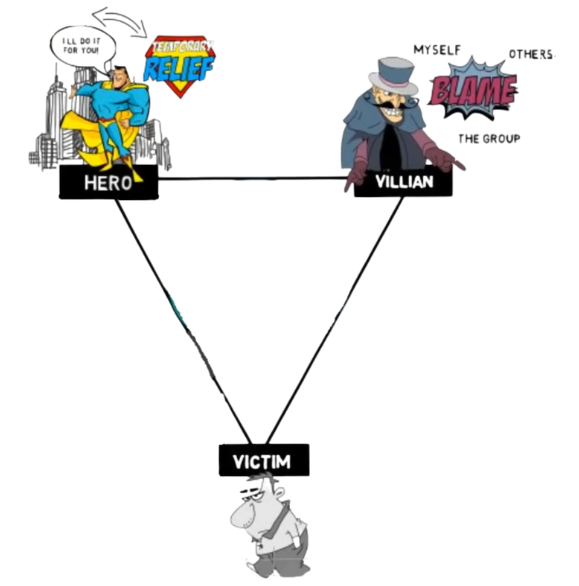
A quick summary:
- Victim
The Victim feels powerless. They believe life is happening to them. Examples:
- "I can’t do anything about this deadline - the PM keeps changing things."
- "It’s not my fault this project is a mess."
Victims wait for someone to rescue them - usually a Hero.
- Villain
The Villain is who the Victim blames. Sometimes it's external, sometimes it's self-directed:
- "The PM keeps increasing the scope."
- "I really messed up that presentation."
- "Leadership has no idea what they’re doing."
- Hero
The Hero tries to save the Victim — by fixing things quickly or offering temporary relief:
- A manager validating your complaint and saying they’ll “deal with it.”
- Ignoring the issue by numbing out — scrolling, binging, drinking.
The trap? None of these roles solve the problem. They just keep the cycle going.
The Drama Triangle at Work: 3 Engineering Management Examples
- The Overpromising PM
In the story that opened this article, I was the Victim. The PM became the Villain. I wanted my manager to step in as the Hero.
Result: That mindset didn’t fix anything. It just kept me in a reactive loop.
- “Your team isn’t working hard enough”
Your manager tells you: “The CEO said your department isn’t working hard enough.”
You go home and rant to your partner: “The CEO is so disconnected. I’m sick of this.”
Your partner agrees with you - they’re playing the Hero.
Result: Nothing changes. The perception sticks. Your team pays the price.
- The Underperforming Developer
You’ve had multiple conversations with a struggling developer. Nothing improves.
You vent to a peer: “I’m stuck with Sean. Why didn’t the last manager fire him?”
Victim mindset again. Sean is the Villain. Your peer might play the Hero by saying, “Ugh, I hate when that happens.”
Result: No progress. Everyone loses.
How to Stop Being a Victim
- Recognize the pattern
The first step is noticing you’re in the triangle. Ask:
- Who am I blaming?
- Who do I want to save me?
Right before I sent that Slack message to my manager and VP, I caught myself. That was the pattern.
- Try HARD to see their side
The next step is even harder - try to imagine the “villain’s” point of view.
I started to think, why did my PM promise that it would be an impossible deadline? who put pressure on him?
Instead of sending that angry message to my manager and the VP Product, I gave the PM a phone call. I calmly asked about that message, what made him do it, and why he didn’t first talk with me.
He then shared how pressured he was in the last couple of weeks, with 3 different executives bugging him every day about that release, putting impossible demands and expecting him to solve it magically.
He apologized for not discussing it with me before the reply. When I told him it’s not easy fixes, he asked me what I think we should do now.
- Focus on outcomes, not problems
The more you focus on a problem, the bigger it becomes. Focus on what you actually want.
I told the PM I’d write the follow-up message in Slack myself:
- Explained the changes were harder than expected
- Shared a new timeline (Wednesday)
- Took responsibility for the delay
It helped us move on. No finger-pointing. No drama.
The Alternative: Creator, Challenger, Coach
In The Power of TED (check it out for a deeper dive), a healthier model is proposed:
- Victim → Creator
- Villain → Challenger
- Hero → Coach
One quote stuck with me:
"For Victims, the focus is always on what they don’t want. For Creators, it’s what they do want."
Creators still deal with problems - but they don’t get stuck in them.
Final Thought
As a newly promoted engineering manager, I remember that I often said the phrase: “That’s important, I wish somebody would finally do something about it!”. I was talking about things outside of my classic responsibility.
Once I learned about the victim->creator transformation, I just started to do many of those things myself (or at least push them along). I complained A LOT less. Instead of being stuck in my own frustration, I try much harder to improve every part of the company - and in some cases, it actually worked!
That shift of mindset was critical in both of my promotions, and I’m sure will help me a lot for the rest of my career (and life).
FAQ: The Drama Triangle for Engineering Managers
Q: Isn’t it valid to be frustrated when people overstep or make bad calls?
Absolutely. Frustration is fine. The key is whether you stay in blame mode or use it as a signal to take action.
Q: How do I know I’m acting like a Victim?
When your thoughts revolve around what someone else did wrong, and what someone else should fix - you’re likely in Victim mode.
Q: What’s wrong with venting to peers or managers?
Venting is fine. But if it doesn’t lead to action, it keeps you stuck. Ask yourself: “What am I going to do about this?”
Q: Isn’t it the PM’s job to manage timelines and communicate?
Yes. But it’s your job to manage how you respond when they mess up. You don’t have to fix everything - but you do have to lead.
Q: Can you be in the Drama Triangle even if you're technically right?
Totally. Being “right” doesn’t protect you from being stuck. Blame is still blame - even if justified.